
My Child Has Rough Little Bumps on the Backs of Their Arms and Their Cheeks That Won't Go Away. Is It Keratosis Pilaris, and Can Anything Clear It Up?
Yes, most of the time. Rough, dry little bumps that feel like sandpaper or fine goosebumps, sitting on the backs of the upper arms and on the cheeks and staying put for months, are usually keratosis pilaris. It is very common in children, it is harmless, and you did not cause it. There is no cure, but a steady routine of gentle moisturizing, along with a mild exfoliating cream on the arms, softens the bumps and calms the redness, and many children see it fade as they grow.
Medically reviewed by Dr. Michael Paltiel, MD - Board-Certified Dermatologist | 17+ Years Experience | Last Updated: August 2026
That is the short answer. Below is how to be sure it is keratosis pilaris, what actually helps, and what is safe to use on a child's face.
How to tell keratosis pilaris from eczema, acne, and an allergic rash
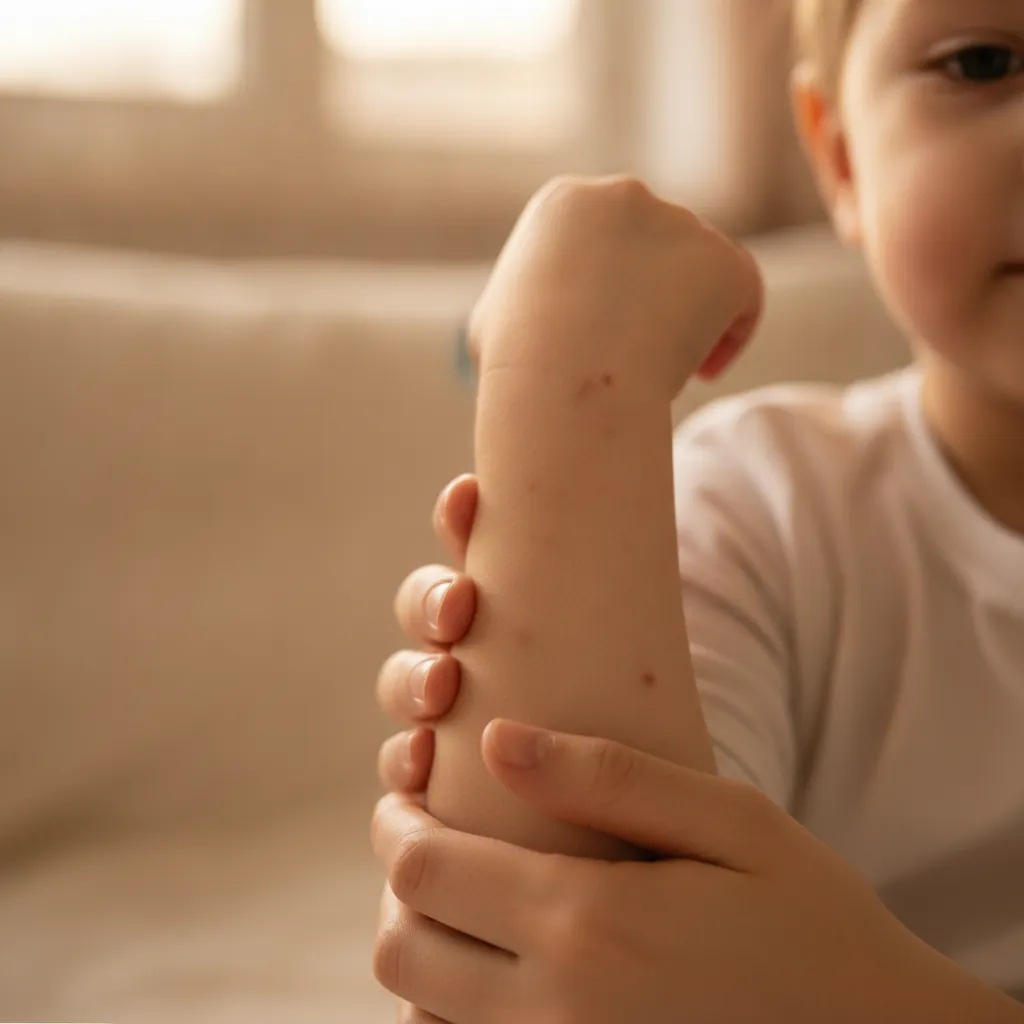
Keratosis pilaris has a texture you can feel before you can see it. Run a hand over the back of your child's upper arm and it feels like fine sandpaper or a patch of goosebumps that never quite smooths out. The bumps are tiny, the same size or a touch bigger than a pinhead, and each one usually sits over a hair follicle. They are skin-colored on the arms and often pink or a little red on the cheeks. They stay dry rather than crusty or oozing, and they usually don't itch. The pattern is symmetric, showing up on both arms, both cheeks, both thighs, or the buttocks in a matching way.
A few things get mistaken for it:
- Eczema is itchy and shows up as dry, inflamed patches that often weep or flake, and it favors the creases like the inside of the elbow and behind the knees. Keratosis pilaris and eczema often appear on the same child, and dry skin makes both more noticeable.
- Acne has whiteheads, blackheads, or tender pus-filled spots, and true acne usually starts around the teenage years, not in a toddler. Keratosis pilaris has none of those. It stays a field of small dry bumps.
- An allergic or contact rash tends to be itchy, appears after a new soap, food, or plant, and comes and goes. Keratosis pilaris sits in the same spots for months.
- Ringworm forms a single round patch with a raised, clearing ring, which is a different look from the even scatter of keratosis pilaris.
On the cheeks the picture is a little different, and it trips up a lot of parents. Facial keratosis pilaris often looks like persistent fine redness with rough bumps, and it is easy to read as chapped cheeks, eczema, or a reaction. It is common in young children and is still the same harmless condition.

Why the bumps showed up, and why they favor the arms and cheeks
Keratosis pilaris happens when keratin, the protein that makes up the surface of the skin, builds up and plugs the opening of the hair follicles. Each plug makes one small rough bump. There is a strong inherited tendency, so if you or your partner had chicken skin as a child, that is very often where it came from. It is not a sign of poor hygiene, and it is not caused by anything in your child's diet.
The backs of the upper arms, the thighs, the buttocks, and the cheeks are simply the areas where this happens most, and the cheeks are a common spot in younger children specifically. Dry skin makes every bump stand out more, which is why the condition tends to look worse in winter and in dry indoor heat, and softer in humid summer months. Children with dry skin or eczema tend to notice it more, and children who also have eczema often do better with the bumps once the underlying dryness is under control.
Can anything actually clear it up?
Here is the honest version. There is no cure that makes keratosis pilaris gone for good, and it often returns if you stop caring for the skin. What a good routine reliably does is soften the bumps, fade the redness, and keep the skin comfortable, and many children improve steadily as they get older.
The routine that works is built around moisture first and gentle exfoliation second:
- Keep baths and showers short and lukewarm rather than hot, and use a mild, fragrance-free non-soap cleanser.
- Apply a thick cream or ointment moisturizer while the skin is still damp, within a couple of minutes of the bath, to seal water in. Creams and ointments hold up better than thin lotions. Twice a day helps.
- On the arms, thighs, and buttocks, a gentle exfoliating cream with urea, lactic acid, or salicylic acid loosens the keratin plugs over time. These work slowly, over several weeks, so the win is consistency rather than any single strong product.
- Run a humidifier in the bedroom during dry months.
Give any routine a few weeks before you judge it, and expect maintenance rather than a one-time fix.
What is safe to use on your child's cheeks
The face needs a gentler hand than the arms. A child's facial skin is thinner and reacts more, so the strong exfoliating acids that help on the arms can leave the cheeks red and irritated. For the face, keep it simple: a mild cleanser, a bland fragrance-free moisturizer morning and night, and daily sunscreen once your child is old enough for it. Skip adult acne washes and scrubs on facial keratosis pilaris, since they tend to inflame it rather than smooth it. If the cheeks stay red or you want an active product for the face, let a dermatologist choose and guide it rather than experimenting at home.
What not to do
A few common instincts make keratosis pilaris worse:
- Do not scrub the bumps with a rough loofah or washcloth. Hard scrubbing irritates the skin and deepens the redness without smoothing the texture.
- Do not pick or squeeze the bumps. Picking is what actually leaves marks, and on the cheeks it can turn a harmless texture into a scab.
- Skip hot water and harsh, fragranced soaps, which strip the skin and make the bumps stand out more.
- Do not over-exfoliate. More acid more often is not better, and on a child it usually backfires into stinging and redness.
Will my child grow out of it, and will it scar?
Keratosis pilaris is harmless, and it often eases with age. Many children see it settle noticeably by their late teens or adulthood, though some carry a milder version longer. The condition itself does not scar. What can leave a mark is picking and scratching, and on deeper skin tones the aftermath of irritation can show up as temporary darker spots, called post-inflammatory pigmentation, that usually fade over months. Leaving the bumps alone and keeping the skin moisturized is the surest way to protect against any lasting change.
When to see a dermatologist about the bumps
Most keratosis pilaris is a home-care condition, but a visit is worth it when the bumps are red, itchy, or inflamed, when weeks of gentle moisturizing have not helped, when you are not certain the bumps are keratosis pilaris rather than eczema or something else, when the cheeks are looking increasingly red, or when the texture is bothering your child socially. A dermatologist can confirm the diagnosis in one look, sort keratosis pilaris from the conditions it imitates, and set up a routine matched to your child's skin and age.
Keratosis pilaris care for children at Adult and Pediatric Dermatology in Forest Hills
Children's skin is half of what this office does, and the name says so. The same practice treats infants, children, teens, and adults, so a parent bringing a five-year-old in for rough cheeks and bumpy arms sits in the same schedule as everyone else. The team looks at persistent rashes and bumps in children of every age and gives you a straight answer on what it is and what to do about it.
Care is led by board-certified dermatologist Dr. Michael Paltiel, who founded the practice in Forest Hills in 2008. Children are also seen by Zina Goldvekht, PA-C, and Aleksey Babakhanov, FNP, a board-certified family nurse practitioner. Keratosis pilaris is a medical dermatology visit, and most major insurance plans are accepted for it.
"My 3 year old took to him quickly and we had a smooth visit with no tantrums, he left happy and even said thank you doctor which never happens!"
Crystal C
"Friendly and knowledgeable staff. Dr. Patel is extremely gentle and patient with my son who is 5 years old."
Wendy Medina
To have your child's skin checked and get a routine that fits their age, call (718) 896-3376, or request an appointment at our Forest Hills office.
Frequently asked questions
Is keratosis pilaris contagious?
No. It is not an infection and does not spread from child to child or from one part of the body to another. Other children in the house cannot catch it.
Did I cause it by not moisturizing enough, or is it a food allergy?
Neither. Keratosis pilaris is inherited and comes from how the skin forms keratin. Dry skin makes it more visible, so moisturizing helps a lot, but a lack of it did not cause the condition, and food is not the trigger.
Why does it look worse in winter?
Cold air and dry indoor heat pull moisture out of the skin, which makes each bump more obvious. Many families see it calm down in humid summer months and flare again when the heat comes on.
Will scrubbing the bumps off work?
No. The bumps are plugged follicles, not dirt, and scrubbing irritates the skin and worsens the redness. Gentle moisturizing and mild exfoliating creams do more than any amount of scrubbing.
Is it a sign of anything serious?
Generally no. Keratosis pilaris is a harmless, isolated finding for most children. It sometimes travels with dry skin or eczema, which a dermatologist can address at the same visit.
Disclaimer: This information is provided for educational purposes and is not a substitute for professional medical advice, diagnosis, or treatment. Please schedule a consultation with our team to discuss your individual needs.
Medically reviewed by Dr. Michael Paltiel, MD
Board-certified dermatologist at Adult and Pediatric Dermatology in Forest Hills, Queens, treating medical, surgical, and cosmetic skin conditions for adults and children.
Related Treatments
Questions About Your Skin? We Can Help.
Schedule a consultation with our board-certified team at our Forest Hills, Queens office.
This information is provided for educational purposes and is not a substitute for professional medical advice, diagnosis, or treatment. Please schedule a consultation with our team to discuss your individual needs.