
Dermatologist Wart Removal: How the Procedure Works and What to Expect
Medically reviewed by Dr. Michael Paltiel, MD, Board-Certified Dermatologist | 20+ Years Experience | Last Updated: April 2026
Short answer: dermatologists remove warts using one of five evidence-based methods, cryotherapy (liquid nitrogen freezing), electrocautery and curettage (burning then scraping), pulsed-dye laser, topical prescription acids (cantharidin, salicylic acid 40 percent, podophyllin), and immunotherapy injections. The right method depends on wart type and location. Common warts on the hands resolve in 1 to 3 cryotherapy sessions, plantar warts on the feet often need 3 to 6, and stubborn or facial warts may need a combination approach. Pain is mild to moderate during the freeze, and recurrence runs roughly 10 to 30 percent depending on type. Below: every method explained, a wart-type-to-method comparison table, recovery timeline, and the most common patient questions. For appointments, see wart treatment at our Forest Hills office.
What Are Warts? A Quick HPV Recap
Warts are small, usually painless skin growths caused by the human papillomavirus (HPV). The virus enters through tiny cuts or breaks in the skin and triggers excess keratin production, which forms the visible bump. Warts are common, contagious through direct contact, and almost always benign, but they can be persistent, painful (especially plantar warts), or cosmetically distressing. The main types:
- Common warts appear on hands, fingers, and around the nails.
- Plantar warts appear on the soles of the feet and grow inward, which is why they hurt with pressure.
- Flat warts are smaller, smoother, and tend to appear in clusters on the face, legs, or back of the hands.
- Filiform warts are thread-like growths most often on the face, eyelids, or neck.
- Periungual warts grow around or under the fingernails and toenails.
- Genital warts require specialized care and are caused by specific high-risk HPV strains.
Warts are sometimes confused with molluscum contagiosum, another HPV-adjacent viral skin infection. The two are treated similarly but not identically.
The 5 Wart Removal Methods Dermatologists Use
Cryotherapy (liquid nitrogen)
Cryotherapy is the most common dermatology wart removal method. Liquid nitrogen at minus 196 degrees Celsius is applied with a cotton swab or spray gun directly onto the wart for roughly 10 to 30 seconds. The freeze destroys the infected tissue, which blisters and falls off over the next 1 to 2 weeks. Most common warts clear in 1 to 3 sessions spaced 2 to 4 weeks apart. Plantar warts usually need more sessions because the skin is thicker.
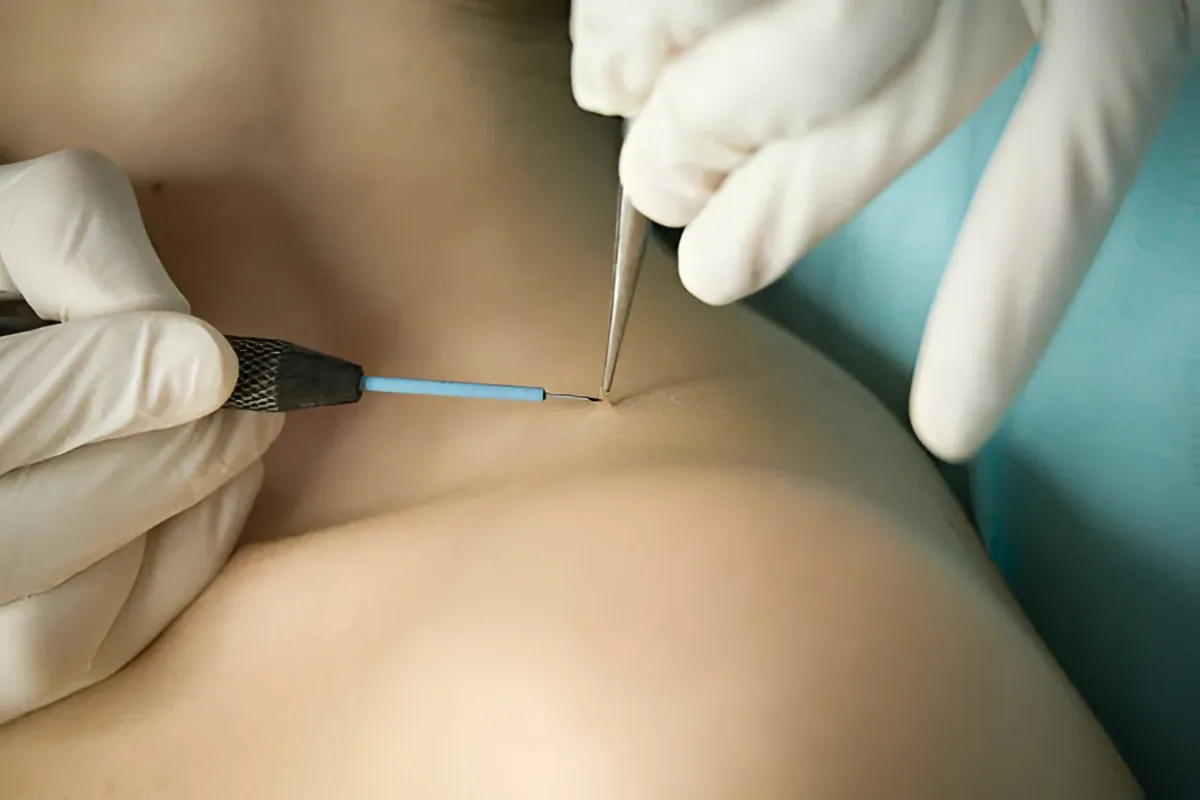
Electrocautery and curettage
This method uses a fine electric needle to burn the wart, then a small curette scrapes away the destroyed tissue. It is fast (single visit for most warts), highly effective, and is the preferred approach for filiform warts on the face, neck, and eyelids. Local anesthesia (lidocaine injection) is used. There is a small risk of scarring, so this method is reserved for warts that have not responded to cryotherapy or are in locations where curettage works better.
Pulsed-dye laser
Pulsed-dye laser targets the small blood vessels feeding the wart, cutting off its blood supply. The wart shrinks and falls off over a few weeks. Laser is reserved for stubborn or recurrent warts, plantar warts that have failed cryotherapy, and warts in cosmetically sensitive areas where scarring must be minimized. It typically requires 2 to 4 sessions spaced 4 to 6 weeks apart.
Topical prescription acids
For warts that are too large, too numerous, or in locations where freezing or burning isn’t ideal, dermatologists prescribe stronger topical acids than over-the-counter products:
- Cantharidin (beetle-derived blistering agent) is painted on, covered with tape, and the blister forms over 24 hours. The wart lifts off as the blister heals.
- Salicylic acid 40 percent (much stronger than the 17 percent in OTC kits) softens and dissolves the wart layer by layer over 4 to 8 weeks of nightly application.
- Podophyllin is reserved for genital warts and is applied in-office only.
Immunotherapy (intralesional injections)
For warts that have failed multiple rounds of standard treatment, dermatologists can inject Candida antigen or measles-mumps-rubella (MMR) antigen directly into one wart. The immune system responds to the antigen and clears not just the injected wart but often nearby untreated warts as well. Immunotherapy is the strongest tool for resistant or widespread warts but is usually a second-line option due to cost and access.
“There’s no single best wart removal method. A plantar wart on a runner needs a different plan than a flat wart on a teenager’s face. Picking the right method is half the job, and that’s the part you can’t get from a drugstore.”
Dr. Michael Paltiel, MD
Which Method Works for Which Wart Type?
| Wart type | Best first-line method | Typical sessions |
|---|---|---|
| Common (hands, fingers) | Cryotherapy | 1 to 3 |
| Plantar (soles of feet) | Cryotherapy plus topical acid | 3 to 6 |
| Flat (face, legs) | Topical retinoid plus light cryotherapy | 4 to 8 |
| Filiform (face, neck) | Curettage or electrocautery | 1 |
| Periungual (around nails) | Cryotherapy plus topical | 4 to 6 |
| Genital | Cryotherapy, podophyllin, or immunotherapy | Variable |
The Wart Removal Procedure: Step by Step
Most cryotherapy and topical visits take 15 minutes or less from check-in to check-out. The visit usually runs:
- Skin exam. The dermatologist confirms the lesion is a wart and not something more serious (occasionally what looks like a wart is a corn, callus, seborrheic keratosis, or rarely a skin cancer that warrants skin cancer screening).
- Method selection. Based on wart type, location, prior treatments, and patient factors (skin tone risk for hyperpigmentation, scarring tolerance, downtime).
- Treatment. Cryotherapy takes 10 to 30 seconds per wart. Curettage and electrocautery are 5 to 10 minutes after lidocaine. Topical acids are applied and bandaged.
- Aftercare instructions, follow-up booking, and return-visit cadence (typically 2 to 4 weeks).
Recovery, Aftercare, and Recurrence
After cryotherapy, expect a blister to form within 24 to 48 hours, often filled with clear or slightly bloody fluid. Do not pop it, the blister roof protects the healing tissue. The blister dries, scabs, and falls off over 1 to 2 weeks. Keep the area clean and dry, apply a thin layer of petroleum jelly under a non-stick bandage if needed, and avoid soaking (long baths, pools, hot tubs) for 5 to 7 days.
After electrocautery or curettage, expect a small scab. Wound care is the same: clean, dry, petroleum jelly, no soaking. Healing typically takes 1 to 2 weeks.
Recurrence runs roughly 10 to 30 percent depending on wart type, with plantar warts the most likely to come back. This is not a failure of treatment, the underlying virus may still be present in adjacent skin and can re-form a visible wart over time.
“About one in five warts comes back in the same spot, and that’s normal. We don’t treat that as a failure, we treat it as a sign the immune response needs a different angle, often immunotherapy injections.”
Dr. Michael Paltiel, MD
Why See a Dermatologist Instead of OTC Wart Treatment?
Drugstore wart removers are mostly salicylic acid at 17 percent, which works for small, thin common warts but fails on thicker plantar warts, flat warts, and warts on the face or near the eye. Board-certified wart removal wins on four fronts:
- Diagnosis accuracy. Not every bump is a wart. Misdiagnosing a corn, a molluscum lesion, or a skin cancer as a wart and treating it with OTC acid wastes weeks and risks harm.
- Stronger tools. Liquid nitrogen, electrocautery, laser, prescription-strength cantharidin and 40 percent salicylic acid, and immunotherapy are not available in any drugstore.
- Cosmetic outcome. A dermatologist matches the method to the location to minimize scarring, especially on the face and hands.
- Resistant warts. If a wart has failed 4 to 6 weeks of OTC treatment, it is unlikely to clear with more of the same. The next step is in-office.
When to See a Dermatologist for Warts
You don’t need to wait for a wart to fail OTC treatment. Book a consultation when:
- The wart is on your face, eyelid, lips, or genitals
- The wart is painful, especially when walking (plantar wart)
- You have multiple warts or warts that are spreading
- You are immunocompromised (HIV, transplant recipient, on biologics)
- The lesion bleeds, changes color, or grows rapidly (skin cancer rule-out)
- You have diabetes (foot warts in diabetic patients always warrant in-office care)
For Elmhurst dermatology patients, our Forest Hills office is roughly a 10-minute drive and runs same-week wart consultations. Quick in-office cryotherapy is one of our most-booked walk-back appointments.
Bottom Line: How Dermatologist Wart Removal Works
Five methods (cryotherapy, electrocautery and curettage, laser, topical prescription acids, immunotherapy) cover essentially every wart that walks through the door. Most patients clear common and filiform warts in 1 to 3 visits, plantar warts in 3 to 6, and resistant warts with immunotherapy. Recurrence is normal and is treated as a signal to switch methods, not give up. Visit our Forest Hills office for in-office wart removal that doesn’t involve guesswork. For authoritative consumer-facing reading, the American Academy of Dermatology wart overview is the best non-product reference.
Frequently Asked Questions About Dermatologist Wart Removal
How do dermatologists remove warts?
Dermatologists remove warts using one of five evidence-based methods: cryotherapy (liquid nitrogen), electrocautery and curettage, pulsed-dye laser, topical prescription acids (cantharidin, salicylic 40 percent, podophyllin), or immunotherapy injections. The choice depends on wart type, location, prior treatments, and the patient’s skin and pain tolerance.
Is dermatologist wart removal painful?
Cryotherapy causes a sharp cold burn that lasts 10 to 30 seconds during the freeze, with mild soreness for 1 to 2 days afterward. Electrocautery and curettage are done after a numbing lidocaine injection, so the procedure itself is painless, with mild post-procedure soreness. Topical acids are not painful in office. Pediatric patients and patients with multiple warts may benefit from topical numbing cream applied 30 minutes before cryotherapy.
How many sessions does wart removal take?
Common warts on the hands typically clear in 1 to 3 cryotherapy sessions spaced 2 to 4 weeks apart. Plantar warts on the feet often need 3 to 6 sessions because the skin is thicker. Filiform warts on the face usually clear in a single curettage visit. Resistant warts that have failed cryotherapy may need laser or immunotherapy as a second-line option.
Do warts come back after dermatologist removal?
Recurrence runs roughly 10 to 30 percent depending on wart type, with plantar warts the most likely to come back. The underlying virus may still be present in adjacent skin and can re-form a visible wart over time. Recurrence is treated as a signal to switch methods rather than retry the same one.
How much does dermatologist wart removal cost?
In-office cryotherapy is typically the least expensive option, with most insurance plans covering medically necessary wart removal. Out-of-pocket costs vary by region and plan. Cosmetic-only wart removal (e.g., a small flat wart for purely aesthetic reasons) may not be covered. Our front desk verifies insurance coverage at the time of booking.
Are warts covered by insurance?
Most medically necessary wart removal is covered by insurance, including warts that are painful, bleeding, located in functional areas (palms, soles), or in patients who are immunocompromised. Cosmetic-only removal of a small asymptomatic wart may not be covered. Verify coverage with your specific plan before booking.
Schedule Your Wart Removal Consultation
Ready to schedule a wart removal consultation at our Forest Hills office?
Adult & Pediatric Dermatology, Queens, NY. Call 718-896-3376 or contact our Forest Hills office.
This information is provided for educational purposes and is not a substitute for professional medical advice, diagnosis, or treatment. Please schedule a consultation with our team to discuss your individual needs.
Medically reviewed by Dr. Michael Paltiel, MD
Board-certified dermatologist at Adult and Pediatric Dermatology in Forest Hills, Queens, treating medical, surgical, and cosmetic skin conditions for adults and children.
Related Treatments
Questions About Your Skin? We Can Help.
Schedule a consultation with our board-certified team at our Forest Hills, Queens office.
This information is provided for educational purposes and is not a substitute for professional medical advice, diagnosis, or treatment. Please schedule a consultation with our team to discuss your individual needs.