
Medically reviewed by Dr. Michael Paltiel, MD – Board-Certified Dermatologist | 20+ Years Experience | Last Updated: February 2026
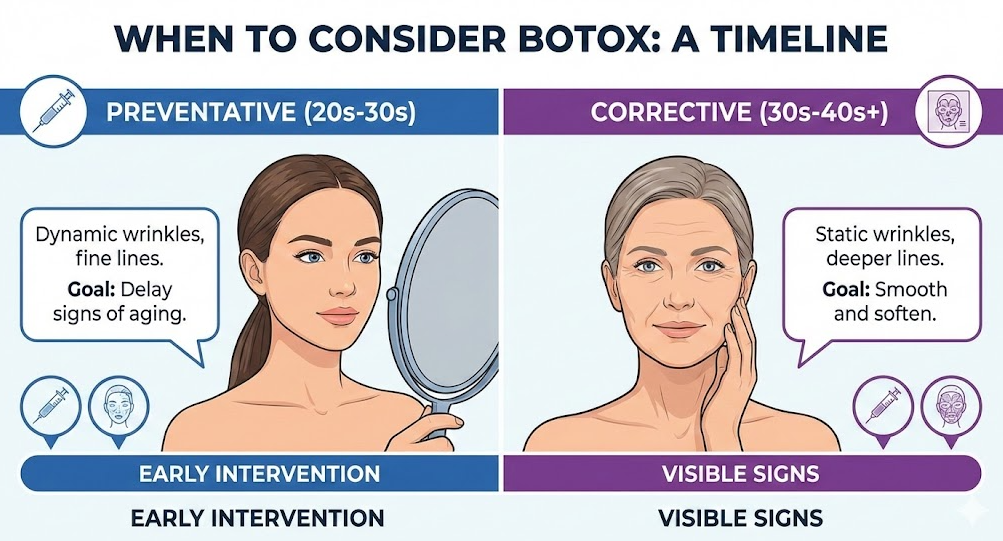
Most dermatologists recommend starting Botox in your late 20s to early 30s, when fine lines first begin to appear at rest. However, there is no single “right” age to start. The best time depends on your skin, genetics, lifestyle, and when you personally notice lines forming that bother you.
At Adult and Pediatric Dermatology in Forest Hills, Queens, we help patients of all ages determine if Botox is right for them. Whether you are considering preventative treatment in your 20s or addressing deeper lines in your 40s and beyond, Dr. Michael Paltiel provides personalized guidance based on your individual needs and goals.
What Is Preventative Botox?
Preventative Botox refers to starting treatment before deep wrinkles form. The goal is to relax the muscles that cause expression lines, preventing those lines from becoming permanently etched into the skin.
When you repeatedly make facial expressions like smiling, frowning, or squinting, the muscles contract and fold the overlying skin. Over years of repetition, these temporary creases become permanent wrinkles that remain visible even when your face is at rest.
By starting Botox while lines are still forming, you can slow or prevent this progression. The muscles learn to stay relaxed, and the skin has less opportunity to develop deep creases.
Preventative Botox has become increasingly popular among patients in their mid-20s to early 30s who want to maintain smooth skin rather than correct established wrinkles later.
Signs You May Be Ready for Botox
Rather than focusing on a specific age, pay attention to what your skin is telling you. Here are signs that you may be ready to consider Botox:
Lines that stay when your face relaxes. Look in the mirror with a neutral expression. If you see lines on your forehead, between your eyebrows, or around your eyes even when you are not making any expression, those are static lines that Botox can help prevent from deepening.
Wrinkles that bother you when you smile. If you notice crow’s feet or forehead lines in photos or the mirror and feel self-conscious about them, that is a valid reason to consider treatment.
Family history of deep wrinkles. If your parents or grandparents developed pronounced forehead lines or frown lines, you may be genetically predisposed to the same. Starting preventative Botox can help you avoid following the same pattern.
Expressive face. If you are naturally very expressive with your facial movements, including lots of smiling, squinting, or frowning, you may develop lines earlier than others. Preventative Botox can help.
Lines that appeared recently. If you have noticed new lines forming in the past year or two, this is often a good time to start treatment before they become more established.
Can You Start Botox Too Early?
You can receive Botox at age 18 or older, but starting too early is unnecessary and not recommended.
If you have no visible lines when your face is at rest and your dynamic lines (lines that appear with expression) are minimal, you likely do not need Botox yet. Starting treatment when there is nothing to prevent or treat wastes money and provides no benefit.
The goal of preventative Botox is to treat early lines before they become deep. If there are no early lines yet, there is nothing to prevent.
A consultation with a board-certified dermatologist can help you determine if you are a good candidate or if you should wait. An honest provider will tell you if treatment is not yet necessary.
Can You Start Botox Too Late?
It is never too late to benefit from Botox. While the treatment is most effective at preventing wrinkles from forming, it can also soften existing lines at any age.
Patients in their 40s, 50s, 60s, and beyond can still see significant improvement from Botox. The treatment relaxes the muscles that continue to deepen wrinkles, preventing further progression even if lines are already established.
For deeper, static wrinkles that remain visible at rest, Botox is often combined with other treatments such as dermal fillers, laser resurfacing, or microneedling to achieve the best results. Your provider can recommend a comprehensive approach based on your concerns.
Botox in Your 20s
In your 20s, your skin is still relatively smooth and resilient. Most people in their early 20s do not need Botox yet.
However, by the mid to late 20s, some people begin to notice early signs of expression lines, particularly on the forehead. This is especially true for those who are very expressive, spend significant time in the sun, or have a family history of early wrinkling.
For patients in their 20s, Botox is used preventatively. The goal is to relax the muscles before deep lines form. Treatment typically focuses on the forehead and frown lines (the 11s between the eyebrows).
Doses in the 20s are usually conservative, as the goal is prevention rather than correction. Fewer units are needed compared to older patients with established wrinkles.
Botox in Your 30s
The 30s are the most common age to begin Botox treatment. By this decade, most people have developed some visible lines, even if they are still relatively mild.
Common concerns in the 30s include forehead lines, frown lines, and early crow’s feet. These lines may be visible when making expressions and starting to show at rest.
For patients in their 30s, Botox is still largely preventative but may also have a corrective component. The goal is to smooth existing lines and prevent them from deepening.
This is an excellent time to establish a regular Botox routine. Consistent treatment in your 30s can significantly slow the progression of facial aging.
Botox in Your 40s and Beyond
By the 40s, most people have more established wrinkles that are visible even at rest. The skin has lost some collagen and elasticity, and years of expression have created noticeable lines.
Botox remains highly effective in the 40s and beyond, but it is typically used as part of a more comprehensive anti-aging approach. Common additions include dermal fillers to restore lost volume, laser treatments to improve skin texture, and medical-grade skincare to support skin health.
Treatment areas in the 40s often expand beyond the forehead and crow’s feet to include lip lines, marionette lines (lines from the corners of the mouth to the chin), and neck bands.
The goal for patients in their 40s, 50s, and 60s is typically to look refreshed and rested, not to erase all signs of aging. A skilled provider will recommend conservative treatment that softens lines while maintaining natural expressions.
What Happens If You Wait Too Long?
If you wait until wrinkles are deeply established, Botox alone may not be enough to achieve the results you want.
Deep static wrinkles that are visible at rest have become etched into the skin over years of muscle movement. While Botox can relax the underlying muscle and prevent further deepening, it cannot fill in the crease that has already formed.
In these cases, your provider may recommend:
Dermal fillers to add volume and fill in deep lines from beneath the skin.
Laser resurfacing to stimulate collagen production and improve skin texture.
Microneedling to encourage skin renewal and reduce the appearance of fine lines.
A combination approach using Botox plus one or more of these treatments for comprehensive results.
Starting earlier, when lines are still forming, allows Botox to work preventatively and can reduce or eliminate the need for more intensive treatments later.
How to Know If You Are Ready for Botox
If you are wondering whether it is time to start Botox, consider scheduling a consultation. During your appointment, your provider will:
Assess your facial anatomy. They will examine your skin, muscle movement, and any existing lines.
Discuss your concerns. What bothers you? What are your goals? Do you want prevention, correction, or both?
Evaluate your candidacy. Based on your skin, age, and concerns, they will recommend whether Botox is appropriate now or if you should wait.
Create a personalized plan. If you are a candidate, they will recommend which areas to treat and how many units you may need.
An honest, experienced provider will never pressure you to start treatment before you are ready. At Adult and Pediatric Dermatology, we believe in a conservative approach that prioritizes your natural appearance.
Your First Botox Consultation at Adult and Pediatric Dermatology
At Adult and Pediatric Dermatology in Forest Hills, Queens, we welcome patients of all ages who are curious about Botox.
Board-certified expertise. Dr. Michael Paltiel is a board-certified dermatologist with over 20 years of experience in cosmetic and medical dermatology. He completed his medical training at Johns Hopkins University School of Medicine and brings exceptional skill and knowledge to every consultation.
Conservative philosophy. “Not if done properly and conservatively,” Dr. Paltiel says when asked if Botox will make your face look frozen. We believe in using the minimum effective dose to achieve natural, refreshed results.
Honest recommendations. We will never recommend treatment you do not need. If you are not yet a candidate for Botox, we will tell you honestly and discuss when to return.
Personalized care. Every patient is different. We take time to understand your goals and create a treatment plan tailored to your unique needs.
Convenient location. Our Forest Hills office serves patients throughout Queens, Brooklyn, and the greater New York City area, with same-day and weekend appointments available.
Ready to find out if Botox is right for you? Call Adult and Pediatric Dermatology at 718-305-1056 or book your consultation online today.
Frequently Asked Questions
Is 25 too young for Botox?
Not necessarily. If you have visible lines forming at rest or a family history of early wrinkles, preventative Botox at 25 can be appropriate. However, if your skin is still smooth with no visible lines, you may not need treatment yet. A consultation can help you decide.
Is 50 too old to start Botox?
Absolutely not. Patients in their 50s and beyond benefit significantly from Botox. While you may need combination treatments for deeper lines, Botox will still relax the muscles causing wrinkles and prevent further deepening.
How often do I need Botox once I start?
Most patients return for Botox every three to four months to maintain results. With consistent treatment, some patients find they can extend the time between appointments as their muscles become trained to stay relaxed.
Will I look frozen if I start Botox early?
Not if you choose an experienced provider who uses a conservative approach. Early, preventative Botox uses smaller doses and focuses on maintaining natural movement while preventing lines from forming.
How much does Botox cost for a first-time patient?
Cost depends on how many units you need. First-time patients, especially those starting preventatively, typically need fewer units than patients with established wrinkles. At Adult and Pediatric Dermatology, new patients receive 10% off their first treatment.
Disclaimer
Medically reviewed by Dr. Michael Paltiel, MD.
This content is for educational purposes only and is not intended as medical advice, diagnosis, or treatment. Please consult a qualified healthcare provider for personalized recommendations.
About the Author: Dr. Michael Paltiel, MD
Dr. Michael Paltiel is a board-certified dermatologist with over 20 years of experience practicing in Forest Hills, Queens, NY. He specializes in both medical and cosmetic dermatology at Adult & Pediatric Dermatology. Learn more about Dr. Paltiel.