
Medically reviewed by Dr. Michael Paltiel, MD – Board-Certified Dermatologist | 20+ Years Experience | Last Updated: February 2026
Yes, Botox is highly effective for treating excessive sweating. It is FDA-approved for hyperhidrosis and has been shown to reduce underarm sweating by 82 to 87 percent. Results typically last four to six months, making Botox one of the most reliable treatments for people who have not found relief from antiperspirants or other methods.
At Adult and Pediatric Dermatology in Forest Hills, Queens, we treat patients with hyperhidrosis using Botox as part of our medical dermatology services. As a board-certified dermatologist with over 20 years of experience, Dr. Michael Paltiel understands the physical and emotional impact of excessive sweating and provides personalized treatment to help patients regain confidence.
What Is Hyperhidrosis?
Hyperhidrosis is a medical condition that causes excessive sweating beyond what the body needs to regulate temperature. People with hyperhidrosis may sweat heavily even when they are cool, at rest, or in comfortable environments. The sweating can be so severe that it soaks through clothing, drips from the hands, or interferes with daily activities.
There are two types of hyperhidrosis:
Primary focal hyperhidrosis affects specific areas of the body, most commonly the underarms, palms of the hands, soles of the feet, and face. It usually begins in childhood or adolescence and often runs in families. There is no underlying medical cause.
Secondary hyperhidrosis is caused by another medical condition or medication. Conditions that can trigger secondary hyperhidrosis include diabetes, thyroid disorders, menopause, infections, and certain medications. This type typically causes sweating across larger areas of the body.
Hyperhidrosis affects approximately 3 percent of the population, though many people never seek treatment because they do not realize it is a treatable medical condition. If excessive sweating is affecting your quality of life, you do not have to simply live with it.
How Does Botox Stop Sweating?
Botox works by blocking the chemical signals from nerves that stimulate sweat glands. When these signals are blocked, the sweat glands in the treated area stop producing sweat.
Normally, your nervous system activates sweat glands when your body temperature rises. In people with hyperhidrosis, the nerves that signal sweating are overactive and trigger sweat production even when cooling is not needed. Botox temporarily interrupts this communication, giving you relief from excessive sweating.
The treatment only affects the specific area where Botox is injected. Your body continues to sweat normally in other areas, so there is no risk of overheating or disrupting your body’s natural temperature regulation.
Where Can Botox Treat Excessive Sweating?
Botox can be used to treat hyperhidrosis in several areas of the body:
Underarms (axillary hyperhidrosis) are the most common treatment area and the only area FDA-approved for Botox hyperhidrosis treatment. This is often the most effective and comfortable area to treat.
Palms of the hands (palmar hyperhidrosis) can be treated with Botox, though the injections may be more uncomfortable due to the sensitivity of the hands. Some providers use nerve blocks or ice to minimize discomfort.
Soles of the feet (plantar hyperhidrosis) can also be treated, though like the palms, this area is more sensitive.
Forehead and scalp (craniofacial hyperhidrosis) can be treated for patients who experience excessive facial sweating.
If you are unsure whether Botox can help your specific sweating concern, a consultation with our team can help determine the best approach.
What to Expect During Treatment
Botox for hyperhidrosis is a quick, in-office procedure with no downtime. Here is what to expect:
Consultation. Your provider will evaluate your sweating patterns, discuss your medical history, and determine if Botox is the right treatment for you. This is also the time to ask about insurance coverage.
Preparation. The treatment area is cleaned, and a topical numbing cream may be applied to minimize discomfort. For underarm treatment, you may be asked to shave the area a day or two before your appointment.
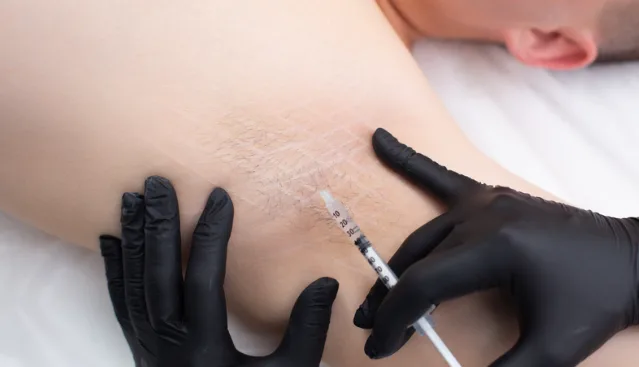
Injection process. Using a fine needle, your provider injects small amounts of Botox just below the surface of the skin in a grid pattern across the treatment area. Underarm treatment typically requires 50 units per side (100 units total). The procedure takes about 15 to 20 minutes.
After treatment. You can return to normal activities immediately. There is no downtime required. You may experience mild soreness, swelling, or bruising at the injection sites, but these effects are temporary.
How Long Does Botox for Sweating Last?
Botox for hyperhidrosis typically lasts four to six months, which is longer than cosmetic Botox for wrinkles. Some patients experience relief for up to 12 months, especially with repeated treatments over time.
You will begin to notice reduced sweating within two to four days after treatment, with full results developing over two weeks. As the effects of Botox gradually wear off, sweating will slowly return. Most patients schedule maintenance treatments two to three times per year to maintain results.
With consistent treatment, some patients find their results last longer over time as the sweat glands become less active.
Does Insurance Cover Botox for Hyperhidrosis?
Because hyperhidrosis is a medical condition, insurance may cover Botox treatment when it is considered medically necessary. Coverage varies by insurance plan, but many patients qualify for at least partial coverage.
To be eligible for insurance coverage, you typically need to demonstrate that:
Other treatments have failed. You have tried prescription-strength antiperspirants or other first-line treatments without adequate relief.
The condition significantly impacts your life. Your excessive sweating interferes with work, social activities, or daily functioning.
Prior authorization is obtained. Your provider submits documentation to your insurance company showing medical necessity.
At Adult and Pediatric Dermatology, we accept most major insurance plans and can help you navigate the authorization process. Our team will work with your insurance company to determine coverage and obtain any necessary approvals before treatment.
If insurance does not cover your treatment or you prefer not to use insurance, we can discuss payment options during your consultation.
Who Is a Good Candidate for Botox Hyperhidrosis Treatment?
Botox for sweating may be right for you if:
Antiperspirants have not worked. You have tried clinical-strength or prescription antiperspirants without adequate relief.
Excessive sweating affects your daily life. You avoid certain clothing, feel embarrassed in social or professional situations, or change clothes multiple times per day.
You want a non-surgical solution. You prefer a minimally invasive treatment without the risks and recovery time of surgery.
You are in good overall health. You do not have any conditions that would make Botox unsafe, such as neuromuscular disorders or allergies to botulinum toxin.
You are not pregnant or breastfeeding. Botox is not recommended during pregnancy or while nursing.
Botox vs. Other Hyperhidrosis Treatments
Botox is not the only option for treating excessive sweating, but it is often the most effective for patients who have not responded to other treatments.
Prescription antiperspirants containing aluminum chloride are usually the first treatment recommended. They work for some patients but can cause skin irritation and may not be strong enough for severe hyperhidrosis.
Oral medications such as anticholinergics can reduce sweating throughout the body but may cause side effects like dry mouth, blurred vision, and urinary retention.
Iontophoresis uses electrical currents to temporarily block sweat glands. It requires regular treatments and works best for hands and feet.
miraDry is a device that uses microwave energy to permanently destroy sweat glands in the underarms. It requires one to two treatments and provides lasting results but is more expensive and only works for underarm sweating.
Surgery (sympathectomy) involves cutting or clamping the nerves that trigger sweating. It is typically reserved for severe cases that have not responded to other treatments due to the risks of permanent side effects.
For most patients with moderate to severe hyperhidrosis, Botox offers the best balance of effectiveness, safety, and convenience.
Hyperhidrosis Treatment at Adult and Pediatric Dermatology
At Adult and Pediatric Dermatology in Forest Hills, Queens, we provide comprehensive care for patients with hyperhidrosis. Our approach combines medical expertise with compassionate, personalized treatment.
Board-certified expertise. Dr. Michael Paltiel is a board-certified dermatologist who completed his medical training at Johns Hopkins University School of Medicine. With over 20 years of experience in medical and cosmetic dermatology, he understands both the physical symptoms and emotional impact of excessive sweating.
Medical dermatology focus. Unlike med spas that focus solely on cosmetics, we are a medical dermatology practice equipped to diagnose and treat hyperhidrosis as a medical condition. This means we can work with your insurance and provide comprehensive care.
Insurance accepted. We accept most major insurance plans and will help you navigate coverage for hyperhidrosis treatment.
Convenient Queens location. Our Forest Hills office is easily accessible for patients throughout Queens, Brooklyn, and the greater New York City area.
If excessive sweating is affecting your quality of life, you do not have to live with it. Call Adult and Pediatric Dermatology at 718-305-1056 or book a consultation online to discuss whether Botox for hyperhidrosis is right for you.
Frequently Asked Questions
How many units of Botox are needed for underarm sweating?
Underarm hyperhidrosis treatment typically requires 50 units per underarm, for a total of 100 units. Your provider will determine the exact amount based on the size of your treatment area and severity of sweating.
Is Botox for sweating painful?
Most patients report only mild discomfort during treatment. The underarms are relatively comfortable to treat. For more sensitive areas like the palms or feet, numbing options are available to minimize discomfort.
Can Botox stop sweating permanently?
No, Botox provides temporary relief lasting four to six months. Maintenance treatments are needed to sustain results. For permanent sweat reduction in the underarms, miraDry may be an option to discuss with your provider.
What if Botox does not work for my sweating?
Most patients see significant improvement with Botox. If results are not adequate, your provider may adjust the dosage or injection technique. Alternative treatments like miraDry or oral medications may also be considered.
Can I use deodorant after Botox for sweating?
Yes, you can continue using deodorant after treatment. Many patients find they need less deodorant or can switch to regular deodorant instead of clinical-strength formulas.
Disclaimer
Medically reviewed by Dr. Michael Paltiel, MD.
This content is for educational purposes only and is not intended as medical advice, diagnosis, or treatment. Please consult a qualified healthcare provider for personalized recommendations.
About the Author: Dr. Michael Paltiel, MD
Dr. Michael Paltiel is a board-certified dermatologist with over 20 years of experience practicing in Forest Hills, Queens, NY. He specializes in both medical and cosmetic dermatology at Adult & Pediatric Dermatology. Learn more about Dr. Paltiel.