
Medically reviewed by Dr. Michael Paltiel, MD, Board-Certified Dermatologist | 20+ Years Experience | Last Updated: February 2026
Yes, microneedling is one of the most effective treatments for acne scars. Clinical studies show patients can achieve 50 to 70 percent improvement in scar appearance after completing a treatment series. At Adult and Pediatric Dermatology in Forest Hills, Queens, Dr. Michael Paltiel, a board-certified dermatologist with over 20 years of experience, regularly recommends microneedling for patients seeking to reduce acne scarring and restore smoother skin texture.
Microneedling works by creating controlled micro-injuries that trigger your body’s natural collagen production. This new collagen helps fill in depressed scars and smooth the skin surface. For many patients who have tried countless topical products without success, microneedling offers a proven solution that delivers visible, lasting results.
How Microneedling Improves Acne Scars
Acne scars form when inflammatory acne damages the deeper layers of skin. When the skin heals, it sometimes produces too little collagen, leaving behind depressions or textural irregularities. Topical treatments cannot reach deep enough to address this underlying collagen deficit, which is why so many products fail to improve acne scarring.
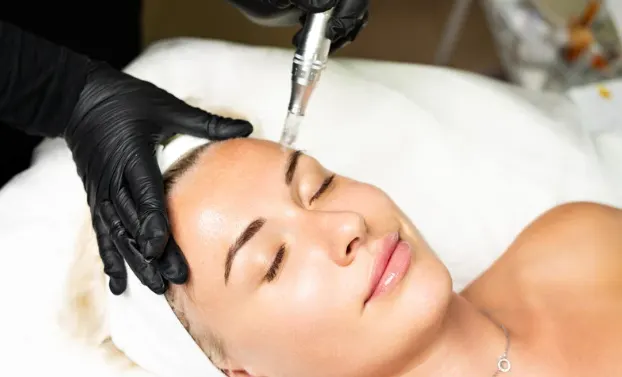
Microneedling addresses the root cause of acne scars by stimulating new collagen production exactly where it is needed. The procedure uses a device with fine needles to create thousands of tiny punctures in the skin. These controlled micro-injuries activate your body’s wound healing response, triggering the production of collagen and elastin.
As new collagen forms over the weeks and months following treatment, it fills in the depressed areas of scarring and creates a smoother skin surface. The collagen remodeling process continues long after the treatment itself, which is why results improve progressively over time.
Unlike treatments that simply resurface the top layer of skin, microneedling works from within. The collagen stimulation happens in the deeper dermal layers where acne scars originate. This makes microneedling particularly effective for scars that have not responded to peels, retinoids, or other surface-level treatments.
Which Types of Acne Scars Respond Best
Not all acne scars are the same, and understanding your scar type helps set realistic expectations for microneedling results.
Rolling scars respond excellently to microneedling. These scars create a wave-like, undulating appearance on the skin surface. They result from fibrous bands pulling the skin downward and are typically shallow to moderate in depth. Microneedling breaks up these fibrous bands while stimulating collagen to lift and fill the depressions. Most patients with rolling scars see dramatic improvement.
Boxcar scars also respond well to microneedling. These scars have sharply defined edges and create a punched-out appearance, similar to chickenpox scars. They can be shallow or deep. Shallow boxcar scars improve significantly with microneedling, while deeper boxcar scars may require more sessions or combination treatments for optimal results.
Ice pick scars present a greater challenge. These narrow, deep scars extend into the dermis and create small, hole-like depressions. Because of their depth and narrow shape, ice pick scars show moderate improvement with microneedling. Many dermatologists recommend combining microneedling with other treatments like TCA cross or subcision for ice pick scars, or patients may need more sessions to achieve satisfying results.
Atrophic scars, the category that includes rolling, boxcar, and ice pick scars, generally respond well to microneedling because they result from collagen loss. Microneedling directly addresses this collagen deficit.
Raised or hypertrophic scars do not benefit from microneedling. These scars form when the body produces excess collagen during healing. Since microneedling stimulates more collagen production, it could potentially worsen raised scars. If you have raised acne scars, your dermatologist will recommend alternative treatments.
What Results Can You Realistically Expect
Setting realistic expectations helps you feel satisfied with your microneedling results. The treatment delivers genuine improvement, but understanding what “improvement” means prevents disappointment.
Studies consistently show 50 to 70 percent improvement in acne scar appearance after a full treatment series. This means your scars will become significantly less visible, but complete elimination is rare for moderate to severe scarring. Most patients find this level of improvement transformative for their confidence and skin appearance.
Improvement manifests as smoother texture, reduced scar depth, smaller pore appearance, and more even skin tone. Scars that once caught shadows and created visible texture become much less noticeable. Many patients report that others no longer notice their scarring after treatment.
Results develop gradually over months as collagen remodeling occurs. You may notice initial improvement within a few weeks after your first session, but the most significant changes appear 3 to 6 months after completing your treatment series. Patience during this period is important because your skin continues improving even when you are not actively receiving treatment.
The severity of your scarring affects your results. Mild scarring often improves dramatically, sometimes approaching complete resolution. Moderate scarring typically shows significant improvement that patients find very satisfying. Severe scarring improves meaningfully but may require additional treatment sessions or combination approaches to achieve optimal results.
Your skin’s individual healing response also influences outcomes. Some patients produce collagen robustly and see excellent results, while others may need additional sessions to reach their goals.
How Many Sessions for Acne Scars
Treating acne scars typically requires more microneedling sessions than treating fine lines or general skin rejuvenation. The depth and extent of scarring necessitate more collagen remodeling than surface-level concerns.
Most patients with acne scars need 4 to 6 sessions spaced about 4 weeks apart. This spacing allows new collagen to form between treatments while maintaining momentum in the healing process. Each session builds on the previous one, creating cumulative improvement.
Patients with mild scarring may achieve their goals with 3 to 4 sessions. Those with more extensive or deeper scarring often benefit from the full 6 sessions and may want additional treatments beyond the initial series.
Your dermatologist will assess your scarring during consultation and recommend a treatment plan tailored to your specific situation. After seeing how your skin responds to the first few sessions, they may adjust the recommendation to ensure you achieve optimal results.
“For most patients, we recommend 3 to 4 sessions for optimal results,” notes the team at Adult and Pediatric Dermatology. “Acne scars or stretch marks may need 4 to 6 sessions, whereas minor texture or pore concerns might be well-addressed with 3 sessions.”
Enhancing Results with PRP or Exosomes
Adding PRP (platelet-rich plasma) or exosomes to your microneedling treatment can enhance results for acne scarring.
PRP uses growth factors concentrated from your own blood. During treatment, blood is drawn and processed to isolate the platelet-rich portion containing powerful growth factors. This PRP is then applied to your skin during or immediately after microneedling. The growth factors penetrate through the micro-channels created by the needles, enhancing the healing response and potentially accelerating collagen production.
Clinical studies suggest that microneedling combined with PRP produces better results for acne scars than microneedling alone. The combination may help patients achieve their goals with fewer sessions or produce more dramatic improvement from the same number of treatments.
Exosomes represent the newest advancement in regenerative aesthetics. These cellular messengers contain growth factors and signaling molecules that support tissue repair. Like PRP, exosomes can be applied during microneedling to enhance results.
At Adult and Pediatric Dermatology, microneedling can be paired and enhanced with PRP or exosomes. During your consultation, we discuss whether these additions make sense for your acne scarring and goals.
Who Should Not Get Microneedling for Acne Scars
Microneedling is safe for most patients, including those with darker skin tones. Unlike some laser treatments that carry hyperpigmentation risks for patients with more melanin, microneedling does not damage or remove the outer layer of skin. This makes it an excellent option for patients of all skin types and ethnicities.
However, certain situations make microneedling inappropriate or require postponement.
Active acne must be controlled before microneedling. Performing the treatment on skin with active breakouts can spread bacteria and worsen acne. If you are currently experiencing breakouts, your dermatologist will help you get your acne under control first, then proceed with microneedling to address the scars.
Patients who have used isotretinoin (Accutane) within the past 6 months should wait before microneedling. This medication affects skin healing, and performing microneedling too soon after isotretinoin can compromise results and increase risks.
Active skin infections, open wounds, or inflammatory skin conditions like eczema or rosacea in an active flare require postponement until the skin stabilizes.
Patients with a history of keloid scarring should discuss their situation carefully with a dermatologist. While microneedling does not typically cause keloids, patients prone to abnormal scarring need careful evaluation.
Pregnant patients should postpone microneedling until after pregnancy and breastfeeding.
During your consultation, we evaluate your skin, review your medical history, and confirm that microneedling is safe and appropriate for your situation.
Microneedling vs Other Acne Scar Treatments
Patients often wonder how microneedling compares to other options for treating acne scars.
Compared to laser treatments, microneedling offers several advantages. It is safe for all skin tones, including darker skin that carries a higher risk of hyperpigmentation with certain lasers. Microneedling also involves less downtime than ablative laser treatments and typically costs less per session.
Compared to chemical peels, microneedling penetrates deeper and stimulates collagen production more effectively. Peels work primarily on the skin surface and are better suited for mild texture concerns and pigmentation than for depressed acne scars. For significant scarring, microneedling delivers superior results.
Compared to dermal fillers, microneedling addresses the underlying cause of scarring rather than temporarily filling depressions. Fillers provide immediate improvement but require ongoing maintenance as the filler dissolves. Microneedling results last longer because they come from your own collagen production.
For many patients, microneedling provides the ideal balance of effectiveness, safety, affordability, and manageable downtime. Some patients with severe scarring benefit from combining microneedling with other treatments like subcision or TCA cross for ice pick scars.
Acne Scar Treatment at Adult and Pediatric Dermatology
At Adult and Pediatric Dermatology in Forest Hills, Queens, we take a comprehensive approach to acne scar treatment. Dr. Michael Paltiel, MD, a board-certified dermatologist, evaluates your scarring, assesses your scar types, and recommends a treatment plan designed for your specific situation.
Our practice has extensive experience treating acne scars with microneedling. We understand that living with acne scarring affects confidence and quality of life, and we are committed to helping patients achieve smoother, clearer skin.
During your consultation, we examine your scars, discuss realistic expectations, and explain how microneedling can help. We may recommend enhancing your treatment with PRP or exosomes based on your scarring severity and goals.
Our Forest Hills clinic serves patients throughout Queens, including Jamaica, Flushing, Rego Park, Astoria, and surrounding neighborhoods. With a 4.7-star rating from over 1,000 Google reviews, patients consistently praise our team as “very professional and experienced” with a “very clean facility” and “great bedside manner.”
To schedule your acne scar consultation, call 718-896-3376 or book online.
Frequently Asked Questions
How long until I see improvement in my acne scars?
You may notice initial improvement within 2 to 4 weeks after your first session. However, significant results develop over 3 to 6 months as collagen remodeling completes. Most patients see clear improvement by their third session and continued enhancement for months after completing their treatment series.
Can microneedling make acne scars worse?
When performed correctly by a qualified provider, microneedling can actually help reduce the appearance of acne scars. However, treating active acne with microneedling can spread bacteria and worsen breakouts, potentially leading to new scarring. This is why it is essential to control active acne before beginning microneedling for scars.
Is microneedling or laser better for acne scars?
Both can be effective, but microneedling offers advantages for many patients. It is safe for all skin tones, involves less downtime, and typically costs less than laser treatments. For patients with darker skin who face hyperpigmentation risks with lasers, microneedling is often the preferred choice. Your dermatologist can recommend the best approach for your specific scarring and skin type.
Will my acne scars come back after microneedling?
Acne scars do not come back after successful treatment. The collagen stimulated by microneedling permanently improves the scar tissue. However, natural aging continues, and some patients choose maintenance sessions every 6 to 12 months to maintain optimal skin quality. If you develop new acne and pick at your skin, new scars could form, so managing acne remains important.
Does microneedling work for ice pick scars?
Microneedling can improve ice pick scars, but these deep, narrow scars typically respond less dramatically than rolling or boxcar scars. Many dermatologists recommend combining microneedling with other treatments like TCA cross for ice pick scars, or patients may need additional sessions. During your consultation, we assess your scar types and recommend the most effective approach.
Disclaimer
Medically reviewed by Dr. Michael Paltiel, MD.
This content is for educational purposes only and is not intended as medical advice, diagnosis, or treatment. Please consult a qualified healthcare provider for personalized recommendations.
About the Author: Dr. Michael Paltiel, MD
Dr. Michael Paltiel is a board-certified dermatologist with over 20 years of experience practicing in Forest Hills, Queens, NY. He specializes in both medical and cosmetic dermatology at Adult & Pediatric Dermatology. Learn more about Dr. Paltiel.